Inside the Plot to Kill Ivanka
Plus: The Headless Snake and the Mysterious Ancient Power of Kharg Island

Analysts are describing the current command structure of the Islamic Revolutionary Guard Corps (IRGC) as “a snake with its head cut off,” arguing that the organization appears increasingly reactive rather than strategic.
The situation has intensified following reports on Telegram that an Iraqi national named Muhammad Baqir Al-Saadi, who runs with a terrorist group supported by the IRGC, is leading a revenge plot targeting Ivanka Trump.
The motive reportedly stems from the 2020 killing of IRGC Quds Force commander Qassem Soleimani in Baghdad.
Al-Saadi vowed to end her life and had obtained a blueprint of her home on the exclusive Indian Creek Island near Miami Beach.
The 32-year-old Al-Saadi is a prominent figure in Iraqi and Iranian terror circles and posted on Telegram the location of Ms. Trump’s $24 million house which she shares with her husband, and three children.

Al-Saadi wrote in Arabic: “I say to the Americans look at this picture and know that neither your palaces nor the Secret Service will protect you. We are currently in the stage of surveillance and analysis. I told you, our revenge is a matter of time.”
According to the DOJ, Al-Saadi was arrested in Turkey and charged with 18 attacks and attempted attacks across Europe and the US.
Most of Al-Saadi’s suspected targets were Jewish interests, and he is accused of involvement in the shooting at the US consulate in Toronto and the arson attack on the Bank of New York Mellon in Amsterdam in March.
At sea, the danger is escalating just as rapidly.
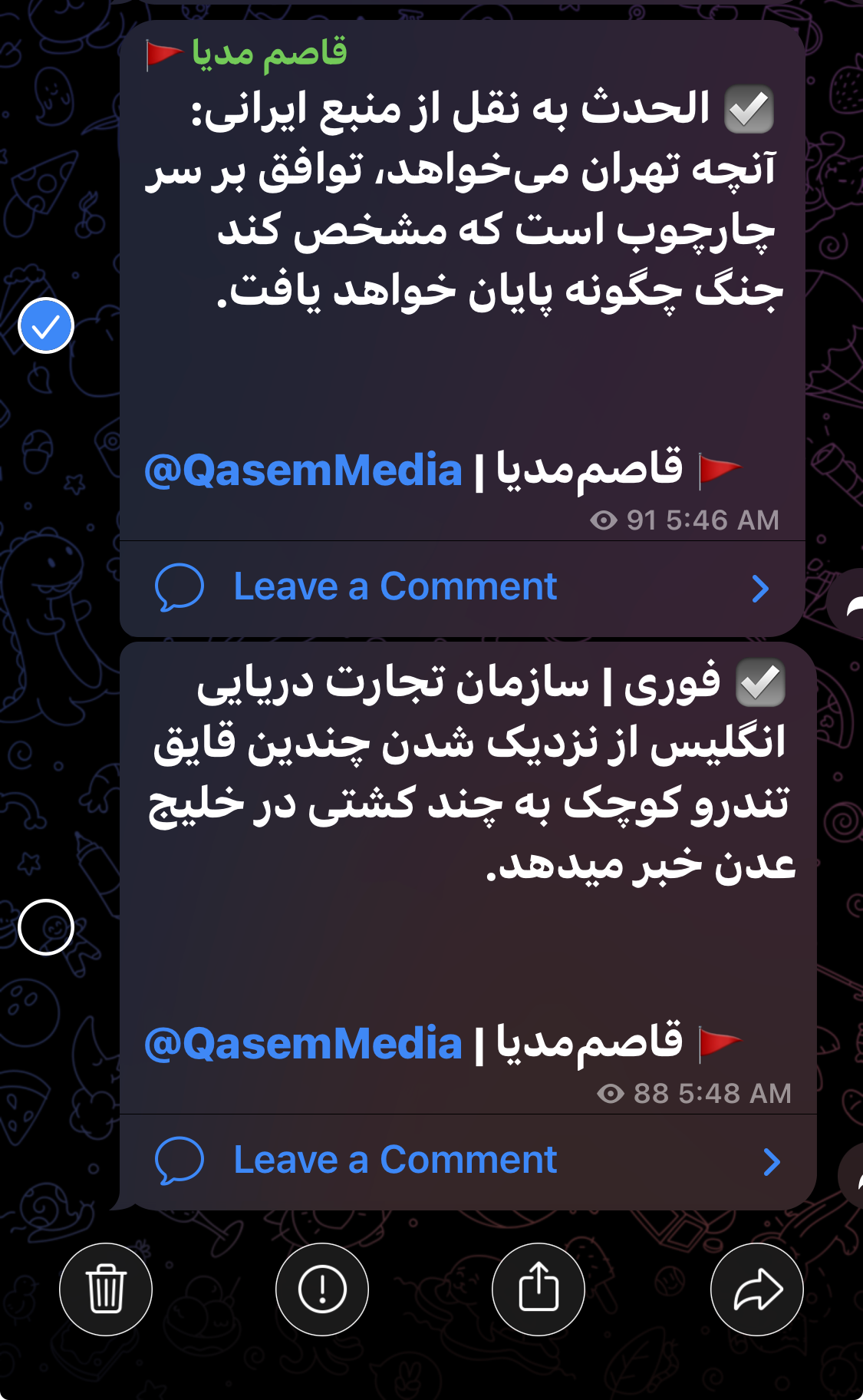
The United Kingdom Maritime Trade Organization warns that several small fast boats carrying weapons and ladders were approaching commercial vessels in the Gulf of Aden — a tactic frequently associated with Iranian proxy harassment operations and asymmetric naval pressure campaigns. The alert quickly spread across Telegram:
Meanwhile, local reports from Bandar Abbas indicated that commercial traffic at Rajaei Port had slowed dramatically amid fears of maritime disruption and blockade conditions.
All roads in this crisis increasingly point toward Kharg Island, which for now appears to be the center of the universe.
The Island That Powers Iran
Kharg Island is known inside Iran as Jazireh-ye Kharg and often referred to as the “Forbidden Island.” The small coral outcrop in the Persian Gulf has evolved from an ancient trading post into one of the most strategically important energy hubs on Earth. Nearly 90% of Iran’s oil exports pass through its terminals.
Whoever controls Kharg controls the lifeblood of the Iranian economy.
Kharg Island lies approximately 25 kilometers off Iran’s coast and roughly 660 kilometers northwest of the Strait of Hormuz — the world’s most critical maritime oil chokepoint.
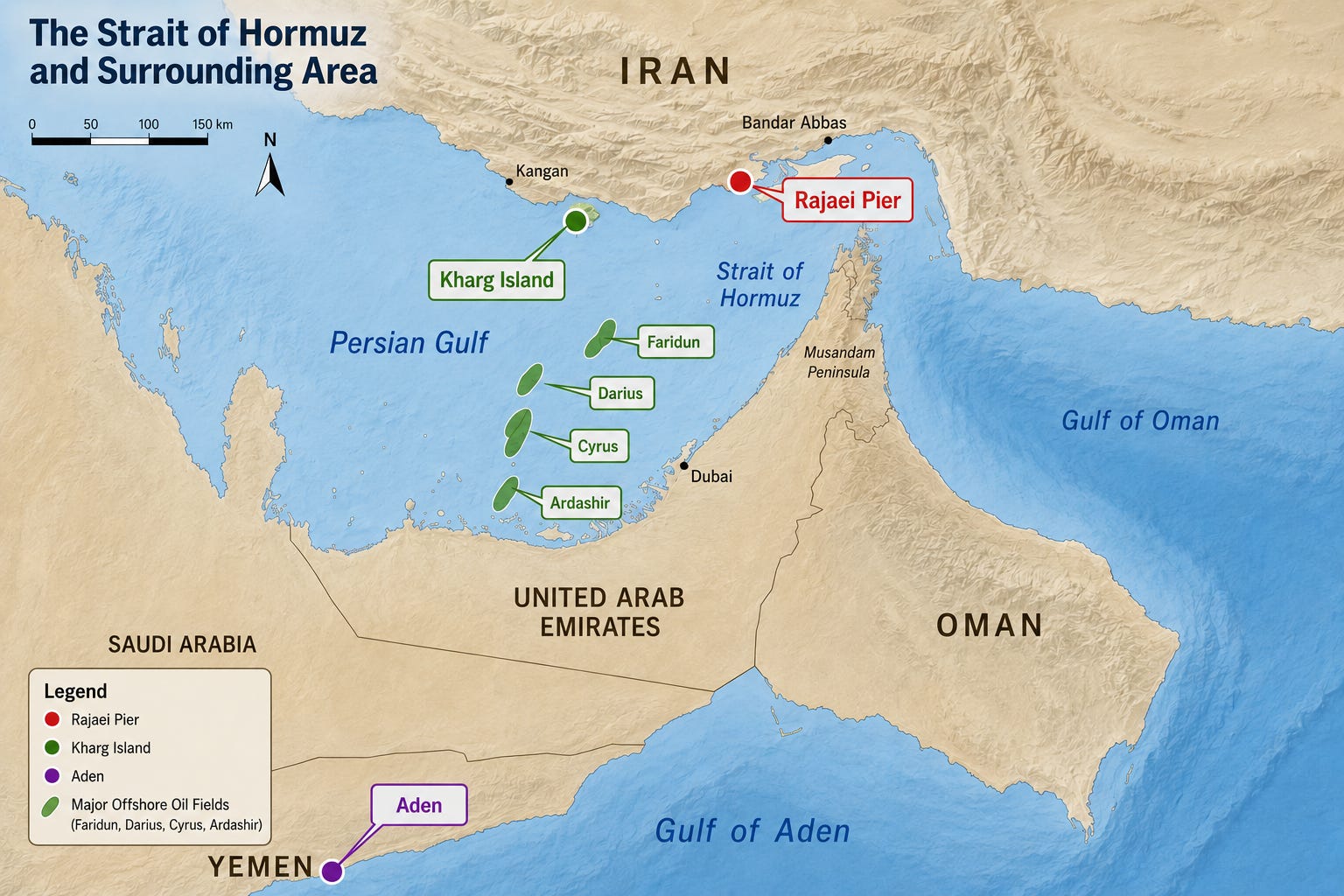
Though physically small — only about 8 kilometers long — its strategic value is enormous.
The island functions as Iran’s primary oil export terminal and contains storage facilities capable of holding up to 30 million barrels of crude oil. Pipelines from major offshore oil fields including Faridun, Darius, Cyrus, and Ardashir feed directly into Kharg’s infrastructure.
For decades, Kharg has been the beating heart of Iran’s energy economy.
In the 1960s, under Shah Mohammad Reza Pahlavi, the island was transformed into a massive oil export hub through partnerships between the National Iranian Oil Company and the American energy giant Amoco. By the mid-1970s, Kharg had become the largest offshore crude oil terminal in the world.
Following the 1979 Iranian Revolution, the island became even more critical as sanctions isolated Iran from global markets. Tehran doubled down on self-reliance and fortified Kharg heavily under IRGC protection.
Access today remains tightly restricted.
The island is guarded by the IRGC and surrounded by layers of military infrastructure, surveillance systems, and anti-access defensive measures. Its reputation as the “Forbidden Island” is not symbolic — it is literal.
Kharg Through the Centuries
Long before Kharg Island became the nerve center of Iran’s oil economy, it was a crossroads of civilizations, empires, religions, and maritime trade routes stretching across the Persian Gulf and into the Indian Ocean.
Its strategic importance did not begin with oil.
It began with geography.
Located roughly 25 to 28 kilometers off Iran’s southern coast and positioned along critical shipping corridors between Mesopotamia, Persia, India, and the Arabian Peninsula, Kharg evolved over centuries into one of the Gulf’s most valuable maritime outposts.
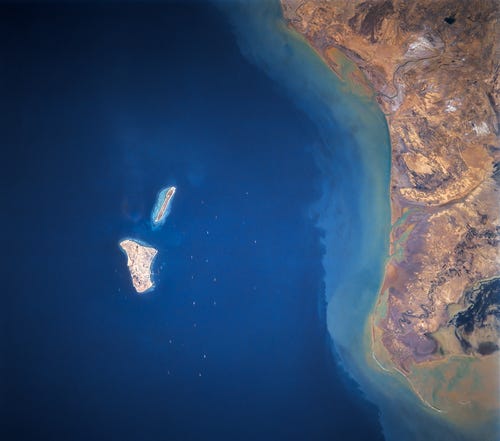
The island’s name itself shifted repeatedly across history — appearing in maps and records as Kharg, Khark, Kharej, and Kharaj — reflecting the influence of Persian dialects, Arab traders, and European cartographers.
Ancient and Medieval Kharg
Archaeological discoveries suggest Kharg was inhabited and commercially active for thousands of years.
The island contains remarkable remnants of ancient civilizations, including:
Tombs and temples
Achaemenid-era cuneiform inscriptions dating between 550 and 330 BCE
The ruins of a Christian monastery believed to date back as far as the 7th century
These discoveries reveal that Kharg was not simply a military or trade outpost, but also a religious and cultural center linking Persia to broader regional networks.
By the 10th century, medieval Islamic geographers already recognized Kharg as an important source of pearls and maritime commerce. The island appears in the Hudud al-‘Alam around 982 CE and later in the writings of Persian geographers such as Abu Esḥāq Eṣṭaḵri.
Kharg became a vital stopover point for ships sailing between India and Basra, one of the great commercial hubs of the Islamic world.
Its economy during this period revolved around:
Pearling
Maritime trade
Fruit cultivation
Date palm agriculture
In 1218, famed geographer and bibliographer Yāqut al-Hamawi visited the island, documenting its role in regional commerce and seafaring networks.
Portuguese Expansion and the Colonial Gulf
The arrival of European colonial powers transformed Kharg into a contested imperial prize.
In 1507, Portuguese forces under Afonso de Albuquerque and Tristão da Cunha seized control of key Persian Gulf islands, including Kharg, as part of Lisbon’s effort to dominate maritime trade between Europe and Asia.
The Portuguese fortified the region aggressively, using nearby Hormuz as a military-commercial stronghold while constructing defensive infrastructure across Gulf territories.
Kharg became integrated into a vast Portuguese trading empire that stretched from Brazil to Goa to East Africa.
By the mid-17th century, Dutch colonial interests entered the Gulf as the Dutch East India Company challenged Portuguese supremacy.
Dutch sailors renamed the island “Delft” after one of the company’s administrative centers, and by the 18th century the Dutch had established:
A permanent trading station
Residential compounds
Fort Mosselstein
A free port open to multiple nationalities
Kharg earned a reputation as one of the best locations in the Gulf for experienced maritime pilots guiding ships into Basra’s difficult waterways.
The island also briefly became an unexpected religious center.
In 1757, a church was built there, and a Carmelite priest ministered to what was reportedly the largest Catholic community in Persia at the time. Even the Bishop of Isfahan temporarily relocated to Kharg.
But colonial control remained unstable.
Local Arab rulers and Persian power brokers repeatedly challenged European influence. In 1766, Mir Muhanna, the governor of Bandar Rig, expelled the Dutch permanently after relations with local populations deteriorated.
British Occupation and the Modern Persian Gulf
In the 19th century, Kharg again became entangled once again in imperial rivalry.
British forces briefly occupied the island in 1837 during efforts to influence the Siege of Herat, part of the broader “Great Game” competition between Britain and Persia over regional influence.
The British returned during the Anglo-Persian War of 1856, occupying the island once more before eventually withdrawing.
By the early 20th century, Kharg remained sparsely populated and largely peripheral to global affairs — until oil transformed everything.
The Oil Revolution
Under Reza Shah Pahlavi, the island was initially used as a remote place of exile for political dissidents, limiting broader development.
That changed dramatically in the 1950s.
In 1956, Iran began constructing massive oil storage reservoirs on Kharg connected to mainland oil fields through extensive pipeline systems.
By 1960, the first major terminal capable of loading 100,000-ton tankers had been inaugurated.
Additional submarine pipelines and pumping systems rapidly expanded capacity throughout the 1960s. By 1965, Kharg had become the largest oil shipment terminal in the world.
Iranian writer Jalal Al-e-Ahmad visited the island during this transformation and famously called it:
“The orphan pearl of the Persian Gulf.”
The phrase captured both the island’s isolation and its growing strategic importance.
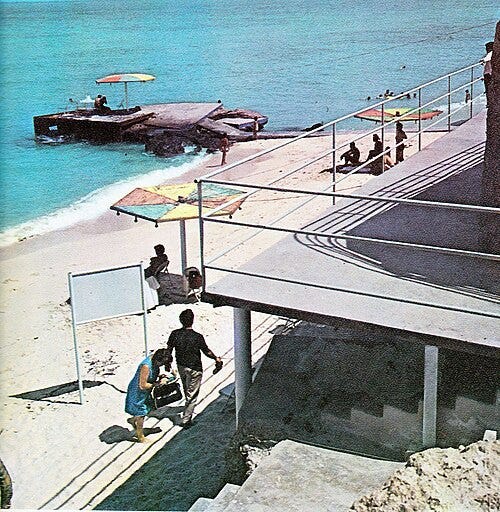
In 1969, the Shah’s government partnered with American oil giant Amoco and the National Iranian Oil Company to develop Kharg into the centerpiece of Iran’s energy export infrastructure.
By the 1970s, the island hosted multiple terminals, chemical facilities, and some of the largest offshore loading infrastructure on Earth.
Revolution, War, and Militarization
The 1979 Iranian Revolution fundamentally changed Kharg’s role.
Amoco’s assets were nationalized, and the island became increasingly militarized under the protection of the Islamic Revolutionary Guard Corps (IRGC).
During the Iran-Iraq War in the 1980s, Iraqi aircraft repeatedly bombed Kharg’s oil facilities in an attempt to cripple Iran’s economy.
The attacks caused severe damage and disrupted exports for years, proving that the island’s enormous strategic value also made it extraordinarily vulnerable.
Yet Iran rebuilt.
Despite sanctions, isolation, and repeated conflict, Tehran expanded Kharg’s infrastructure over subsequent decades, determined to preserve the island as the backbone of its oil economy.
Kharg Today
In 2025 and early 2026, Iran, through Kharg, exported around 1.5 million barrels of oil per day to China. Other Iran ports, and other customer countries show much smaller numbers. In February, Iran increased its oil export to 3 times normal rate, and reduced oil storage. Following the start of the 2026 Iran war on February 28, satellite imagery revealed that Iran had begun reducing oil storage there since early February, probably in anticipation of an attack. The facility had 18 million barrels (58% full), when nine of the oil tanks were estimated to be full by March 7th, compared to mid-January. But instead of filling those tanks to capacity, the regime began dumping oil in the ocean, slowing production, and taking ancient, rusty tankers out of retirement, and using them as floating storage.
In March 2026, it was reported that Israel was considering bombing the island, while the US was favoring seizing it. On March 13, the US bombed military installations on the island. Around 90 military targets were struck, while oil infrastructure on the island was left intact. On April 7, 2026, the US military once again struck military targets on Kharg Island, and shortly thereafter imposed a blockade in the region.
Now Kharg stands as the most strategically important island in the Middle East — an ancient crossroads transformed into a modern geopolitical fortress. A fact that President Trump has long understood.
The only question I have regarding Iran’s remaining military capabilities is can they destroy the petroleum infrastructure in the surrounding gulf countries? I believe they are going to try and “burn it all down”.
Thank you. This is very informative. We don’t hear these things in the regular news.